By Prof. (Dr.) Ripu Ranjan Sinha
Founder, Red Green Movement & Chairman, Viksit Bharat 2047 Development Forum
As we stand at the dawn of the Amrit Kaal, the roadmap toward Viksit Bharat 2047—the vision of a developed India championed by Honorable Prime Minister Shri Narendra Modi Ji—requires a fundamental structural shift in our economic DNA. For decades, India has been celebrated as the “back office of the world,” a service-sector powerhouse. However, to transition into a top-tier developed nation with a $30 trillion economy, we must move beyond being a provider of services to becoming a global leader in Intellectual Property (IP) and Research-Driven Industries.
The transition to a Knowledge-Based Economy is not merely an academic aspiration; it is a strategic necessity.
In a world defined by the Fourth Industrial Revolution, wealth is no longer generated solely by labor or land, but by the ability to innovate, protect, and commercialize ideas.
- Moving Up the Value Chain: While the service sector (IT/BPO) provided the foundation, the next 25 years must belong to the creators. We must evolve from “Make in India” to “Innovate and Own in India.”
- IP-Led Growth: High-value intellectual property—ranging from semiconductor design to biotechnology patents—ensures that the “rent” of innovation stays within our borders, fueling domestic reinvestment.
The Three Pillars of the 2047 Knowledge Strategy
1. Education 4.0: Cultivating the Innovator’s Mindset : To support the Prime Minister’s vision, our education system must undergo a radical transformation. Through the lens of Education 4.0, we are advocating for:
- Curriculum-Industry Convergence: Aligning higher education with frontier technologies like AI, Quantum Computing, and Green Tech.
- Research at the Grassroots: Incentivizing PhDs and research fellowships that solve real-world industrial problems, turning universities into “Innovation Hubs” rather than just degree-granting institutions.
2. Strengthening the IP Ecosystem : A developed India must be an Intellectually Sovereign India. This requires:
- Fast-Track Patenting: Reducing the time for patent grants to global standards to encourage startups to protect their breakthroughs.
- IP Monetization: Creating platforms where academic research can be seamlessly licensed to Indian MSMEs and global giants.
3. The Red-Green Movement in Industry : My “Red and Green” philosophy suggests that technology (Red) must be paired with sustainability (Green).
Research-driven industries of the future—such as Hydrogen Fuel cells, carbon-capture tech, and sustainable agriculture—will be the sectors where India can lead globally. By owning the patents in these “Green-Tech” spaces, India becomes a Vishwa Mitra (Global Friend) that exports solutions, not just products.
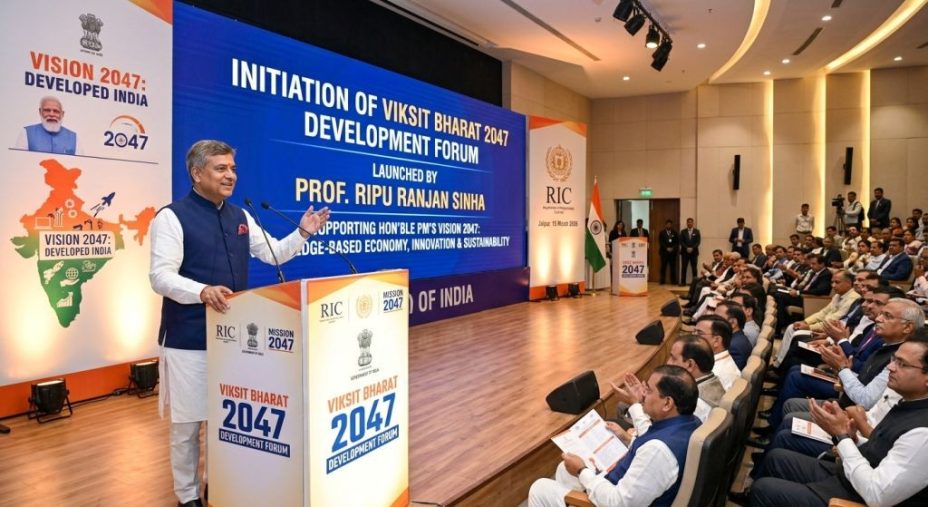
The Viksit Bharat 2047 Development Forum, launched at the Rajasthan International Center, serves as the bridge between visionary policy and ground-level execution. Our mission is to facilitate a “Quadruple Helix” model—where Government, Academia, Industry, and Civil Society work in a synchronized loop.
“Our goal is to ensure that by 2047, an ‘Indian Patent’ carries the same global prestige as the highest standards of international innovation.”
Honorable Prime Minister Modi Ji has often stated that this is the time (Yahi Samay Hai, Sahi Samay Hai).
For our youth, the message is clear: do not just seek a job; seek a patent. Do not just offer a service; build a solution.
By transitioning to a knowledge-based economy, we are not just increasing our GDP; we are securing the dignity and prosperity of 1.4 billion citizens. Together, through research, innovation, and intellectual courage, we will realize the dream of a Viksit Bharat @ 2047.
The author is a renowned academician, Union Minister for the Royal Kingdom of Mazibuko, and a leading advocate for Digital Transformation and Sustainable Development in India.










 English
 Arabic
 Chinese (Simplified)
 Dutch
Dutch French
 German
 Hindi
Hindi Italian
 Japanese
 Latin
Latin Nepali
 Polish
 Portuguese
 Russian
 Spanish
 Tamil
Tamil Thai
Thai Urdu
Urdu