By: Prof. (Dr.) Ripu Ranjan Sinha
Global Promoter of Innovation, Peace, and Sustainable Development
The year 2026 has presented the world with a paradox. While we advance toward unprecedented technological frontiers, the resurgence of global conflict—particularly the destabilization of West Asian corridors—has reminded us that the path to progress is rarely a straight line.
For India, under the visionary leadership of Honorable Prime Minister Narendra Modi, this “year of the storm” is not a deterrent, but a defining moment for the Viksit Bharat 2047 mission.
As we look toward the centenary of our independence, the current global war serves as a critical stress test for our national resilience, our “Aatmanirbharta” (self-reliance), and our role as a “Vishwa Mitra” (friend to the world).
The 2026 conflict has underscored a fundamental truth: Strategic Autonomy is the cornerstone of a developed nation.
India’s refusal to be drawn into rigid power blocs while simultaneously securing its energy interests and maritime trade—exemplified by our continued operation of the Chabahar Port and our balanced engagement with global powers—is a masterclass in modern diplomacy.
For Viksit Bharat, this means building an India that is not dependent on the whims of global supply chains but is a vital, irreplaceable link within them.
My “Red-Green Movement” philosophy emphasizes that Science & Technology (Red) must serve Sustainable Development and Peace (Green).
The 2026 crisis has accelerated this integration:
- The Energy Pivot: The disruption of the Strait of Hormuz has turned our National Green Hydrogen Mission from a long-term goal into an immediate economic shield. By 2047, our reliance on volatile fossil fuel zones must be zero.
- Knowledge Management in Defense: As an advocate for ICT and strategic knowledge, I see the 2026 war as the final push for India to become a “Sovereign Tech Superpower.” Our defense indigenization is no longer just about manufacturing; it is about owning the underlying algorithms, semiconductors, and AI that define modern security.
The Prime Minister’s vision for 2047 rests on four pillars. The 2026 conflict directly challenges these, requiring a proactive “Human-Centric” response:
- Food Sovereignty: To protect our Annadata, we are decoupling agriculture from global fertilizer volatility through Nano-Urea and precision Ag-Tech.
- Youth Empowerment: Our Yuva are being trained not just for jobs, but to lead “Industry 4.0” during global disruptions, ensuring the Indian economy remains a “Sone Ki Chidiya 2.0″—resilient, digital, and prosperous.
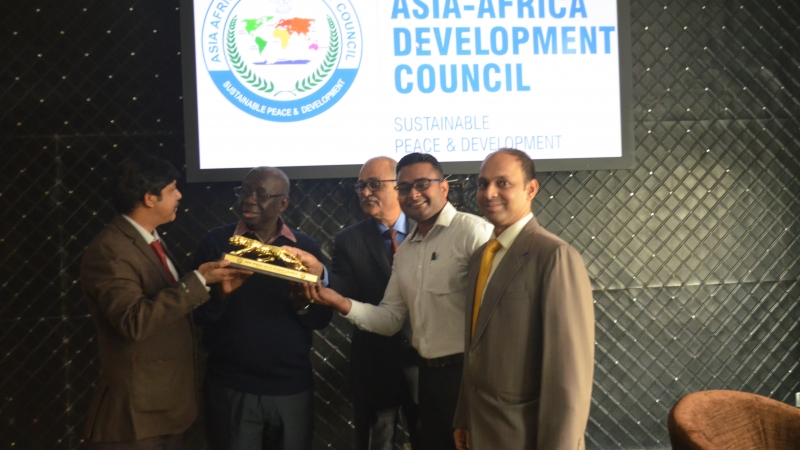
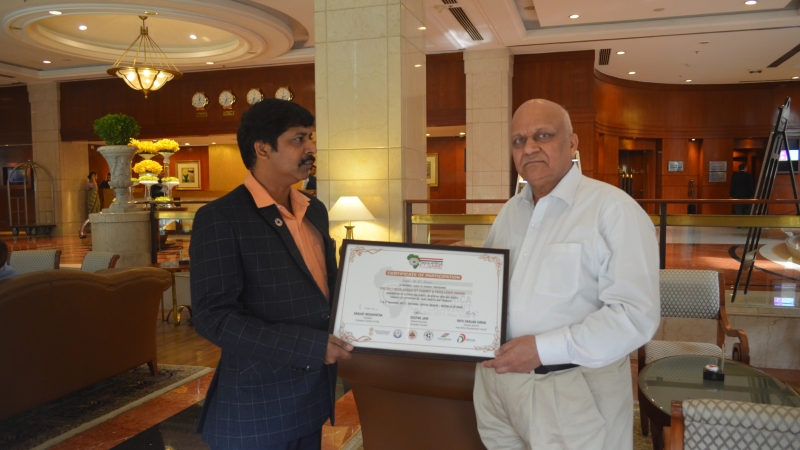
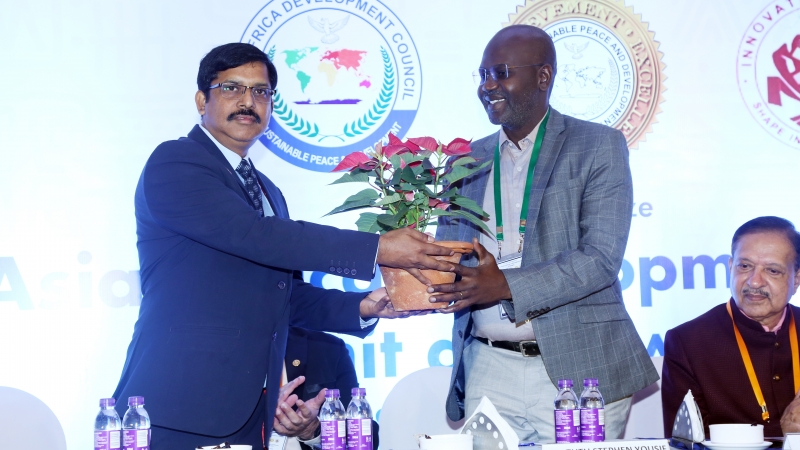
In my capacity with the Asia Africa Development Council (ADCO), I have seen how the world looks to India for a “Third Way.”
Amidst the 2026 war, India’s advocacy for peace is not a sign of neutrality, but of leadership.
A “Viksit Bharat” is not just a wealthy India; it is a moral India that leads the Global South toward stability. By providing humanitarian aid and digital public infrastructure (DPI) to conflict-affected regions, we are building the soft power required of a global superpower.
The global war of 2026 is the “Crucible of Fire” from which a stronger India will emerge. It has exposed the vulnerabilities of the old world order and validated the Prime Minister’s call for a self-reliant, tech-driven, and inclusive Bharat.
As we march toward 2047, let us remember: Innovation thrives in adversity. By aligning our technological prowess with our ancient values of peace and sustainability, we are not just witnessing history—we are writing the roadmap for a Developed India that the world will follow.










 English
 Arabic
 Chinese (Simplified)
 Dutch
Dutch French
 German
 Hindi
Hindi Italian
 Japanese
 Latin
Latin Nepali
 Polish
 Portuguese
 Russian
 Spanish
 Tamil
Tamil Thai
Thai Urdu
Urdu